Saturday, February 9, 2013

Plane and Solid Shapes

After reading The Greedy Triangle and discussing characteristics of 2D (plane) shapes, the students graphed ordered pairs to draw various shapes.


After graphing the shapes, each one was colored a certain color according to its name.


Then, we sorted quadrilaterals and labeled. Students created their own categories to sort when finished.


After learning about 3D (solid) shapes, students identified them with food. Each student was given a bag with various items and sorted them as cylinders, cones, rectangular prisms, spheres, and cubes. The activity was created by Johanna Tackitt and can be found here.


Once sorted and counted, a graph was made. Also, 2 questions were created that could be answered using their graph.


These are the anchor charts for the week.


After all their hard work, students were treated to a Mardi Gras parade put on by Kindergarten. 


In addition, we had a Mardi Gras/Valentine's celebration. Students brought in treats for their classmates. 


Ms. Gros brought cupcakes that she made. There is not much that she can't do :)  
They look and taste AWESOME!! 


Finally, at the end of the day our school held our end of the quarter PBIS award. Students that did not receive more than a phone call home attended a magic show. They were amazed and thrilled at the performance!


HAPPY MARDI GRAS!


Thursday, February 7, 2013

Author's Purpose

Two activities brought the students' understanding of author's purpose to a deeper level.

The first activity is an adapted version of a Skittles activity I saw on Pinterest. Ms. Gros had to change it a bit because fun size packs of Skittles are a seasonal item -- who knew???

Anyway, she bought M&Ms and they worked just as well. Each student received a bag and had to write a few sentences to Persuade, Inform, and Entertain. 


The next day, student pairs were given a random object (such as a greeting card, toothbrush, stuffed animal, Pez dispenser, tote) and an author's purpose. Using their object, the pairs wrote according to their purpose. When each pair was complete, they read their writing and the class had to determine what their purpose for writing (persuade, inform, entertain) was.


Sunday, February 3, 2013

Fractions and Compare/Contrast

We focused on identifying fractions of a set and of a whole for the first week. One activity was to sort jelly beans according to its color and find the fraction of each color. Once fractions were written, the students created individual and group graphs of their jelly bean colors.


During week 2, we focused on comparing, ordering, and equivalent fractions. I found an amazing resource that includes a 4-day lesson on these skills. 

We started the week with an activity from Illuminations. The students used egg cartons to review finding fractions of a set and then discovered equivalent fractions.


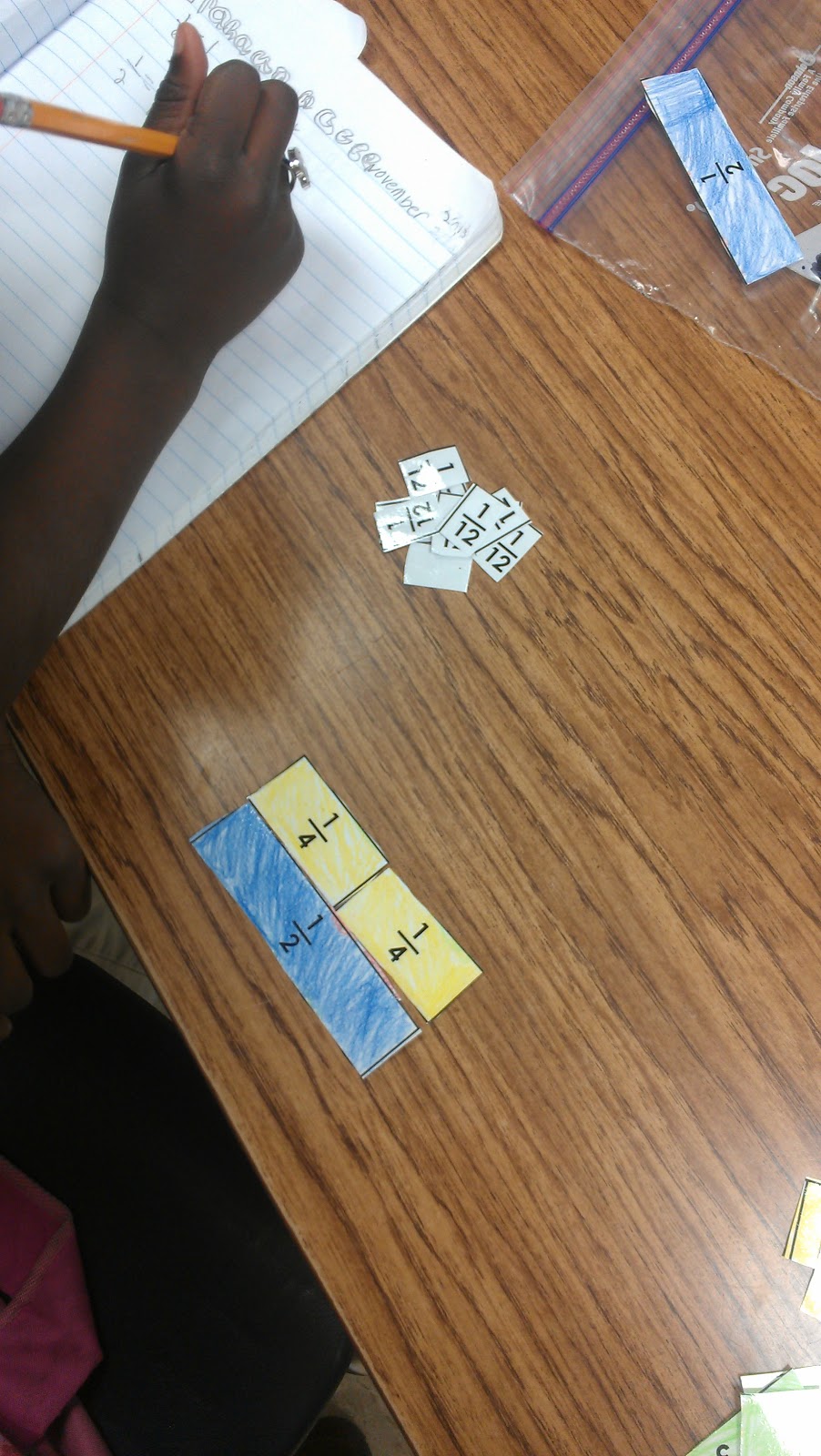
Fraction strips were another manipulative used to find equivalent and compare fractions.


In Reading, we addressed comparing and contrasting. Ms. Gros had each student blindly choose a name of an animal that was written on a piece of paper. Then, they paired up, drew a Venn diagram, and compared and contrasted their chosen animals.


We finished reading Ramona Quimby, Age 8 and began Ramona the Brave.  A Venn diagram has been started to compare and contrast the two books.


Tuesday, January 22, 2013

Masters of Learning

The students are now masters of division! 

They can solve division problems by applying one of these strategies: repeated subtraction, drawing an array, or making equal groups. Our last week on division was spent discovering how it relates to multiplication and creating multiplication and division word problems.

One activity was rolling a die in a die -- it is just that, a die inside another die -- and drawing the number of circles represented by the outside number and drawing stars in each circle represented by the number inside. Then, a multiplication and division sentence was written. 

For example, when the dice was rolled a 3 showed on the outside and a 6 showed on the inside. 3 circles were drawn and 6 stars were drawn in each circle. The multiplication sentence, 6x3=18 and 3x6=18, is written along with the related division sentence, 18/6 = 3 and 18/3=6.


As a review before the test, students played spin and divide. Each pair was given a spinner with numbers, a whole sheet with quotients, and assigned a number to divide by (2, 5, 9, or 10). Each partner took a turn spinning to find a number, divided that number by their assigned number, and found the quotient. The quotient was covered with a chip and the first partner to cover 20 squares won.


This week we begin fractions and I can't wait to share our learning! To prepare, the students colored fraction strips so I can laminate them. They will cut them and use in future lessons.


We read chapters 4 - 6 in Ramona Quimby, Age 8


Our skill for the week was comparing and contrasting. To practice the skill before applying to the book, students compared (similarities) and contrasted (differences) an apple and an orange using a Venn diagram. Then, they again used a Venn diagram to compare and contrast themselves to their partner.


Venn Diagram

Finally, the students compared and contrasted the two sisters from the story ( Ramona and Beezus ).


Translate This Blog